
1. Introduction: The Strategic Imperative of Conscious Respiration
Breath is the fundamental foundation of life—an unbroken chain of respirations spanning from the first infant wail to the final gasp of the elderly. For the modern individual, reclaiming the Yogi Science of Breath is not merely a lifestyle choice; it is a strategic necessity for the mitigation of the physiological degradation caused by the “shadow of civilization.” In an era defined by sedentary habits, environmental stressors, and shallow respiratory patterns, mastering the breath is the primary optimization strategy for reclaiming one’s natural biophysical efficiency.
By transitioning from unconscious, constricted breathing to the conscious control of the respiratory engine, an individual unlocks a suite of high-level benefits:
- Physical Vitality: Complete oxygenation of the blood, increased resistance to contagion and “the white scourge” of consumption, and the stimulation of the vital organs.
- Mental Power: Enhanced cognitive focus, the eradication of fear and worry through neural stabilization, and the storage of vital energy for heightened self-control.
- Spiritual Growth: The unfoldment of latent faculties and the harmonization of the individual soul with the universal rhythm of nature.
To master this force, one must first understand the mechanical engine that converts atmospheric air into the lifeblood of human existence.
What Is the Yogi Science of Breath?
The Yogi Science of Breath teaches conscious respiration techniques that maximize oxygenation, stimulate the diaphragm, regulate the nervous system, and increase Prana—the vital life force described in yogic tradition. By practicing Complete Yogic Breathing and rhythmic breath control, individuals improve immunity, digestion, mental clarity, emotional stability, and spiritual awareness.
2. The Exoteric Perspective: Physiology and the Chemistry of Life
From a Western physiological standpoint, the respiratory system is a mechanical engine designed for metabolic combustion and blood purification. The lungs serve as the site of a miraculous chemical exchange where the “foul stream” of venous blood—blue, dull, and laden with waste—is transformed back into a “fresh stream” of arterial life-force.
When respiration is optimized, arterial blood is richly oxygenated, containing approximately 25 per cent of free oxygen. This specific chemical threshold is vital for health. Under-oxygenation leads to a cascade of systemic failures:
- Impaired Digestion: Without sufficient oxygen, food cannot be properly oxygenated for assimilation, resulting in malnutrition and gastric weakness.
- Thermoregulation Failure: The combustion of waste products in the lungs generates essential body heat; poor breathers lack the “internal fire” to resist cold and temperature fluctuations.
- Systemic Toxemia: When venous blood is not fully purified, poisons are returned to the circulation, manifesting as blood diseases and tissue degeneration.
The primary engine of this system is the diaphragm. In the Yogi Science, the diaphragm is not merely a bellows but a sophisticated mechanism for internal massage. As it descends during inhalation, it vibrates and kneads the stomach, liver, and intestines, strategically forcing blood into the organs and then squeezing it out during exhalation. This rhythmic “pumping” is the secret to a high-functioning nutritional apparatus.
3. The Esoteric Dimension: Prana and the Nervous System Architecture
While Western science focuses on the chemistry of air, the Yogi understands the esoteric reality of Prana, or “Absolute Energy.” This is the universal principle of force that distinguishes the living from the lifeless.
The Architecture of Vitality
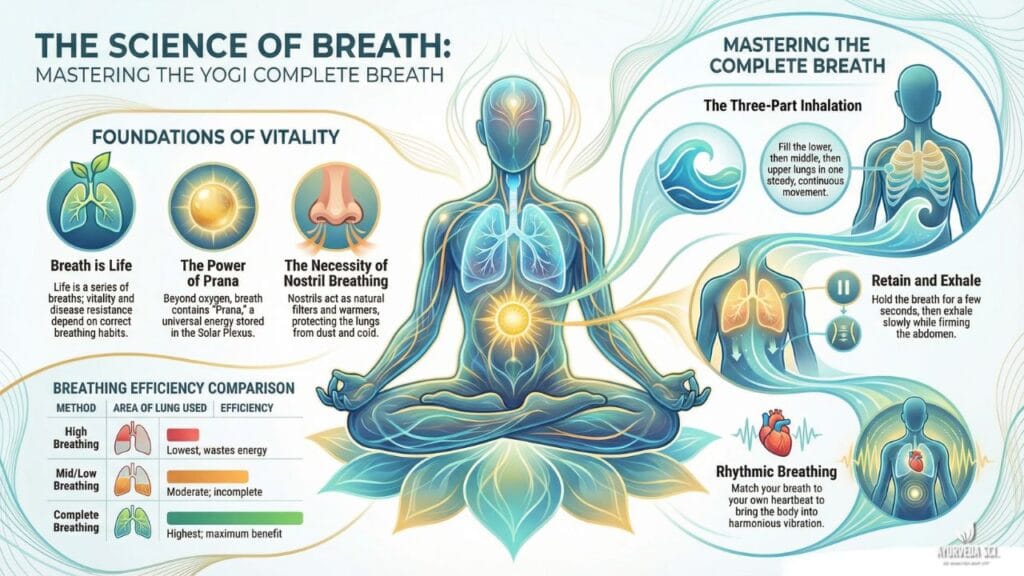
The Yogi distinguishes between Neshemet—the ordinary atmospheric air composed of oxygen and nitrogen—and Ruach, the “spirit of life” or Prana contained within that air. While the circulatory system utilizes oxygen, the nervous system appropriates Prana to power every thought and muscle contraction.
This energy is managed by a sophisticated neural architecture:
- The Cerebro-Spinal System: The “telephone system” of volition and sensation.
- The Sympathetic System: The controller of involuntary processes like growth and nutrition.
- The Solar Plexus (The Abdominal Brain): The central storehouse of Prana. Critically, this center is composed of white and gray brain matter, similar to the upper brains. It serves as the “storage battery” that radiates strength and energy to every part of the system.
By controlling the breath, we draw Prana into these nerve centers, establishing a reserve of “nerve force” that bridges the physical and energetic bodies.
4. The Gateway of Vitality: Nostril Breathing vs. Mouth Breathing
The nasal passages are the only natural gateway for breath, equipped by evolution with a sophisticated protective apparatus. Mouth-breathing is a “barbarous” habit of civilization that bypasses these defenses, inviting disease and systemic inflammation.
The Protective Apparatus
- Filtration: Bristly hairs sieve out dust and impurities before they can reach the delicate lung tissue.
- Warming: Tortuous nasal channels lined with mucous membrane warm the air, preventing “parched” states and throat irritation.
The Oriental Methods of Cleansing
To ensure the gateway remains clear, the Yogi utilizes two primary purification techniques:
- Water Suction: Draw a small amount of water up the nostrils, allowing it to run into the throat to be ejected through the mouth.
- Air Sniffing: Close one nostril with a finger and sniff air vigorously through the other; alternate sides to clear all obstructions. (that also known as Anlom Vilom)
5. The Hierarchy of Respiration: Mastering the “Complete Breath”
Respiratory efficiency is classified into four distinct levels. Most individuals operate at a fractional capacity, ignoring the majority of their lung cells.
| Method Name | Physiological Action | Strategic Weakness |
| High Breathing | Elevates collarbone/shoulders; draws in abdomen. | Minimum air for maximum effort; wastes energy. |
| Mid Breathing | Partially expands ribs; pushes diaphragm up. | Fills only the middle chest; inefficient. |
| Low Breathing | Pushes diaphragm down/abdomen out. | Superior to above, but leaves upper lung cells atrophied. |
| Yogi Complete Breath | Integration of all three; utilizes every muscle and air cell. | None; the pinnacle of biophysical efficiency. |
The Yogi Complete Breath: 3-Step Instructional Guide
The inhalation must be a smooth, continuous motion, avoiding jerky transitions:
- Inhale: Breathe steadily, filling the lower lungs (pushing the abdomen forward), then the middle lungs (protruding the ribs), then the upper lungs (lifting the chest). Crucially, at the end of the inhalation, slightly draw in the lower abdomen; this “abdominal support” provides a base for the lungs and assists in filling the highest, smallest cells of the lungs.
- Retain: Hold for a few seconds to maximize Prana absorption and oxygenation.
- Exhale: Release slowly, maintaining a firm chest and slowly lifting the abdomen as the air leaves.
6. Practical Applications: The Yogi Developing and Minor Exercises
These exercises are strategic tools for “housecleaning” the system and stimulating atrophied cells.
1. The Cleansing Breath (The Foundational Finish)
- Inhale a complete breath and retain for a few seconds.
- Pucker the lips as if to whistle (without swelling the cheeks).
- Exhale a small amount of air with vigor, stop, then repeat until the lungs are empty.
2. Nerve Vitalizing Breath (Stimulating Nerve Force)
- Inhale a complete breath; retain.
- Extend arms in front, limp.
- Draw hands back to shoulders slowly, contracting muscles until the fists are clenched so tightly they tremble.
- Push fists out and back rapidly while maintaining this tension. Exhale vigorously.
3. Vocal Breath (The Whistle Experiment)
To develop resonance, inhale slowly and expel air in one great breath through a wide-opened mouth. The Experiment: Whistle for several seconds to note your facial position. Now, sing or speak without changing that lip or facial position. You will find the tone becomes resonant, clear, and beautiful, proving that facial muscles dictate the timbre of the “Vocal Breath.”
4. Lung Cell Stimulation
- Breathe in slowly. While inhaling, gently tap the chest with fingertips.
- When full, retain the breath and pat the chest with palms. Finish with the Cleansing Breath.
7. Rhythmic Breathing and the Phenomena of Psychic Influence
Rhythm is the universal law of “catching the swing” of nature. By harmonizing the body with this vibration, the Yogi amplifies the power of the Will.
The Pulse Unit: Bio-Individual Rhythm
The standard of measure is the Pulse Unit—the individual’s own heart rate. This ensures the practice is perfectly tailored to your unique bio-rhythm. The ratio is 6:3:6:3 (Inhale 6 beats, Retain 3, Exhale 6, Rest 3).
Psychic Applications and Visualization
- Inhibiting Pain: Direct Prana to the affected area via the Will to re-establish neural balance.
- Healing with “Pumping” Imagery: When treating yourself or others, use a specific visualization: Inhalation is the lifting of a pump handle (drawing in Prana); Exhalation is the actual pumping of fresh energy into the diseased organ to flush out toxins.
- Controlling Emotions: Concentrate on the Solar Plexus and give the mental command “Get Out” during exhalation to expel fear or anger.
- Transmutation of Reproductive Energy: During inhalation, draw the creative force upward to the Solar Plexus or Brain. It must be understood that you are moving etheric pranic energy, not reproductive fluids. This regenerates the system and enhances “personal magnetism.”
8. Spiritual Unfoldment: Consciousness of the Soul and Universe
The ultimate objective of the Science of Breath is the realization of the “Real Self.” The body is the Temple of the Spirit, a useful shell for the Ego, but not the Ego itself.
Soul Consciousness Meditation
Breathe rhythmically in a relaxed position. Meditate on the idea that you are an entity independent of the body—a spirit inhabiting a shell. This practice detaches the Ego from the transitory physical form, creating a profound sense of immortality.
Universal Consciousness Meditation
While breathing rhythmically, visualize yourself as a drop in the ocean of the Universal Mind.
- Inhalation: Draw in the wisdom and strength of the Universe.
- Exhalation: Pass that power and love out to all living things.
By aligning your internal rhythm with the pulse of the infinite through the Yogi Science of Breath, you transition from mere physical survival to spiritual mastery. You reclaim the master key to vitality, transforming your physical temple into a vibrant instrument of the Soul.
Aum.
Recommended Article: Which Pranayamas Can Be Done During Periods?
Frequently Asked Questions (FAQ)
1. What is the Yogi Science of Breath?
The Yogi Science of Breath is an ancient yogic system that teaches conscious breathing techniques to optimize oxygen absorption, activate Prana (vital life force), regulate the nervous system, and enhance physical, mental, and spiritual well-being.
2. What is Prana in yogic philosophy?
In yogic philosophy, Prana is the universal life energy that animates all living beings. While oxygen nourishes the blood, Prana energizes the nervous system and subtle body, governing thought, movement, and vitality.
3. What is Complete Yogic Breathing?
Complete Yogic Breathing is a three-part breathing technique that fills the lower, middle, and upper lungs in one continuous inhalation. It integrates diaphragmatic, rib, and clavicular breathing to maximize lung capacity and oxygenation.
4. Why is nose breathing better than mouth breathing?
Nose breathing filters, warms, and humidifies air before it reaches the lungs. It also promotes nitric oxide production, which improves oxygen delivery and supports immune function. Mouth breathing bypasses these protective mechanisms.
5. How does rhythmic breathing affect the nervous system?
Rhythmic breathing balances the autonomic nervous system by synchronizing respiration with heart rate. This reduces stress hormones, improves focus, stabilizes emotions, and enhances parasympathetic activation.
6. Can breathing exercises increase lung capacity?
Yes. Regular practice of complete yogic breathing and lung stimulation exercises helps expand dormant air cells, strengthen respiratory muscles, and improve overall lung efficiency.
7. How long should I practice yogic breathing daily?
Beginners can start with 5–10 minutes daily. Advanced practitioners may extend to 20–30 minutes. Consistency is more important than duration.