

The journey to restoring your hair’s natural color begins with understanding why it turns gray in the first place. This guide synthesizes ancient Ayurvedic wisdom with modern scientific insights to provide a clear, actionable path forward.
Introduction: Understanding the Root Cause
The Science of Hair Color
At the base of each strand of your hair is a hair follicle. Within these follicles are specialized cells that produce a pigment known as melanin. It is this melanin that gives your hair its natural black, brown, or red color.
Why Hair Turns Gray Prematurely
Premature graying occurs when melanin production stops earlier than it should. Both modern science and Ayurveda offer explanations for why this happens, pointing to damage at the cellular level.
| Modern Science Perspective | Ayurvedic Perspective |
| Factors like chemical exposure, poor diet, stress, smoking, and pollution create unstable molecules called free radicals in the body. | The root cause of premature graying is an imbalance of Pitta dosha, one of the three fundamental energies in the body. |
| These free radicals cause oxidative damage to the melanocyte cells, which are responsible for producing melanin. This damage halts pigment production. | An increased Pitta dosha generates excess body heat. This internal heat travels to the scalp, damaging hair follicles and disrupting melanin production. |
Both perspectives converge on a single truth: premature graying is a symptom of internal distress, whether from oxidative damage (free radicals) or systemic heat (Pitta).
The Promise of Ayurveda
According to Ayurveda, since premature graying is the result of an internal imbalance, it is a reversible process. By using consistent, natural remedies that target these root causes, it is possible to restore your hair’s natural color. Many people who have followed these principles have reported their gray hair turning black again in as little as one to three months.
This guide outlines a holistic, three-step Ayurvedic routine designed to correct these internal imbalances and restore hair health from the inside out.
1. The 3-Step Routine to Restore Natural Hair Color
This routine is a comprehensive approach to healing the body internally, which in turn restores the natural color and vitality of your hair. Commit to this routine with patience, and you will see the benefits.
1. Step 1: Morning Nourishment with Amalaki Rasayana
- What it is: Amalaki Rasayana is a highly potent form of Amla (Indian gooseberry). It is a classical “Rasayana” or rejuvenative tonic, made by processing dried amla in its own juice approximately 21 times to amplify its healing properties.
- Primary Benefits:
- Neutralizes Free Radicals: As a powerful source of antioxidants, it protects melanocytes from the free radical damage that stops color production.
- Balances Pitta Dosha: It directly cools and pacifies the excess body heat (Pitta) that Ayurveda identifies as the primary cause of premature graying.
- Boosts Nutrition: It nourishes the body’s seven core tissues (Saptadhatus), effectively correcting the nutritional deficiencies that can lead to gray hair.
- How to Use: Mix one teaspoon of Amalaki Rasayana with one teaspoon of honey and consume on an empty stomach in the morning. The honey improves taste, increases absorption, and prevents potential acidity.
2. Step 2: Post-Meal Support with Bhringraj Asav
- What it is: Bhringraj Asav is a classical Ayurvedic hair tonic and digestive syrup. It is a self-fermented liquid containing Bhringraj and over ten other beneficial herbs.
- Primary Benefits:
- Cools the Body: It pacifies the excess Pitta dosha throughout the body, helping to repair melanocytes that have been damaged by internal heat.
- Purifies the Blood: It has a strong, positive action on the liver, which helps purify the blood. Healthier blood flow leads to healthier hair follicles.
- Improves Digestion: Often, due to issues like gas and indigestion, the nutrition from your food fails to reach your hair follicles. As a natural probiotic, Bhringraj Asav solves this by improving digestion and ensuring the nutrients you consume are properly absorbed and delivered to your hair.
- Acts as a Hair Vitamin: The powerful blend of herbs acts as a comprehensive tonic, correcting the nutritional deficiencies that contribute to graying.
- How to Use: Mix four tablespoons (20 ml) of Bhringraj Asav with an equal amount of water. Drink this mixture after meals, once or twice daily.
3. Step 3: Nightly Scalp Therapy with Nilibhringadi Oil
- What it is: Nilibhringadi oil is a classical Ayurvedic formulation specifically cited in ancient texts like the Ashtanga Hridayam and Sahastra Yogam for its ability to reverse premature graying (Palitya).
- Primary Benefits:
- Protects from Damage: When applied to the scalp and hair, it forms a protective barrier against oxidative damage.
- Reduces Scalp Heat: The oil has a cooling effect on the scalp, which directly helps pacify the localized Pitta dosha that is damaging hair follicles.
- How to Use:
- Pour a small amount of oil into a metal ladle (kadchi). Hold it over a gas flame for just 10 seconds to warm it.
- Pour the warm oil into a glass bowl (not steel).
- Massage it thoroughly into your scalp before going to sleep.
- In the morning, wash it out with a mild shampoo. For best results, use this oil at least every other day.
This internal routine addresses the long-term causes of graying. For an immediate, external solution, the following recipe provides natural color without harmful chemicals.
2. A Natural 2-Step Recipe for Instant Hair Color
Commercial hair dyes often contain harsh chemicals like PPD, ammonia, and hydrogen peroxide that can damage hair follicles. This two-step herbal recipe is a safe, chemical-free alternative that not only colors your hair but also deeply nourishes it.
1. Step 1: The Henna Base (for a Reddish-Brown Foundation)
- Ingredients:
- 3 tbsp Henna (Mehndi) Powder
- 1 tbsp Amla Powder
- 1 tbsp Bhringraj Powder
- 2 tbsp Aloe Vera Gel
- Hot Tea Water (brewed from 1 tsp tea leaves)
- Instructions:
- In an iron pot, combine the Henna, Amla, and Bhringraj powders. (The iron reacts with the henna to produce a deeper, darker color.)
- Add the aloe vera gel and just enough hot tea water to form a smooth, consistent paste.
- Cover the pot with plastic wrap and let it rest overnight. This allows the henna to release its natural pigment.
- The next morning, first wash your hair with a natural shampoo and dry it to remove excess oil and dirt.
- Apply the paste thoroughly, covering every strand. Leave it on for 3 hours, then rinse it out using water only. Do not use shampoo.
2. Step 2: The Indigo Finish (for a Deep Brown or Black Color)
- Ingredients:
- 3 tbsp Indigo Powder (same amount as Henna)
- Warm Tea Water (leftover from Step 1)
- Instructions:
- Immediately after rinsing the henna from your hair, mix the indigo powder with warm tea water to create a smooth paste.
- Apply the indigo paste to your hair immediately after mixing. The dye in indigo begins to degrade quickly.
- For Dark Brown: Leave the paste on for 30-40 minutes.
- For Jet Black: Leave the paste on for 1.5 to 2 hours.
- Rinse your hair thoroughly with water only.
3. Critical Aftercare Rules
To ensure a deep, long-lasting color, follow these two rules strictly:
- NO SHAMPOO: Do not wash your hair with shampoo for at least 48 hours after rinsing the indigo. This crucial waiting period allows the color to fully oxidize and set.
- NO OILING: Wait at least 24 hours before oiling, but for the deepest, most long-lasting color, it’s best to wait a full 48 hours.
While these external and internal remedies are powerful, their effectiveness is greatly amplified by proper nutrition.
3. Nourish from Within: 5 Key Foods for Healthy Hair
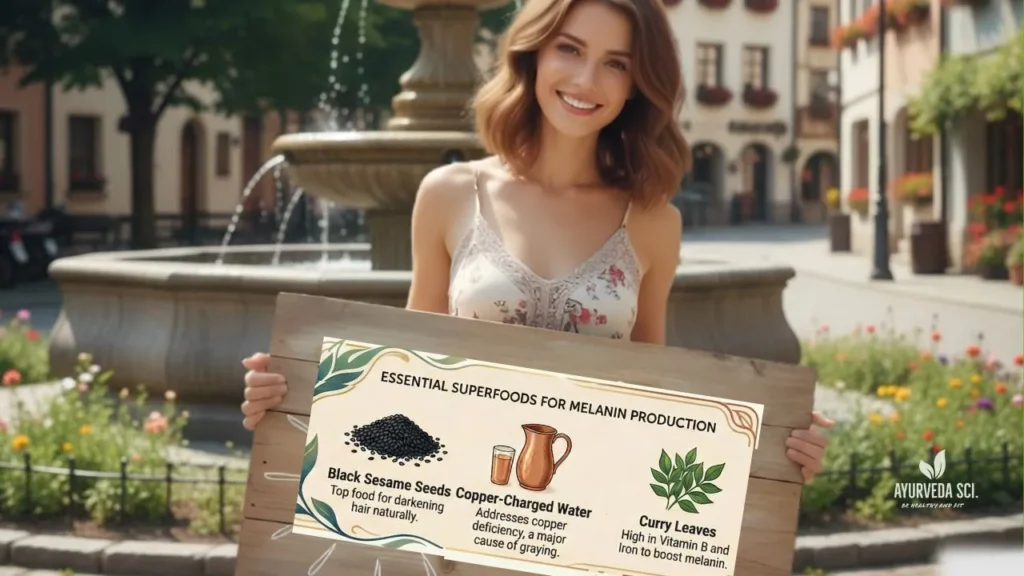
Poor dietary choices are one of the biggest reasons for premature graying. When the body is nutritionally deprived, its innate intelligence prioritizes vital organs like the heart, liver, and kidneys. It thinks, “Even if hair turns white, work will go on.” This is why hair health is often the first casualty of a poor diet. Integrating the following foods provides the essential nutrients for healthy pigment production.
- Amla (Indian Gooseberry): As one of the world’s most powerful antioxidant foods, Amla directly fights the free radicals that cause hair to gray.
- Black Sesame Seeds (Kaale Til): Considered one of the best foods in Ayurveda for reversing gray hair.
- Copper-Charged Water: A deficiency in the mineral copper is a significant factor in premature graying, and water stored in a copper vessel is an excellent way to address this.
- Curry Leaves (Kadi Patta): Rich in B-vitamins and iron, these leaves provide crucial nutrients that help boost the body’s natural melanin production.
- Raw Onion: A source of sulfur, a key component of keratin, which improves the structural integrity of the hair.
4. Conclusion: The Path to Permanently Healthy Hair
The Ayurvedic approach to reversing premature gray hair is a journey of reclaiming your health from the inside out. It is built on three pillars that work together to create lasting results.
- The internal 3-step routine (Amalaki Rasayana, Bhringraj Asav, Nilibhringadi Oil) rebalances your system and restores pigment production at the root.
- The external 2-step natural dye provides immediate, chemical-free color while deeply nourishing your hair.
- A supportive diet rich in hair-healthy foods provides the fundamental building blocks for strong, vibrant hair.
These methods work, provided you follow them with dedication. If you try them for a few days and then quit, you will not see results. The most important factor in this journey is consistency. By diligently following this holistic routine, you can correct the imbalances causing gray hair and permanently restore its natural color and vitality.