1. Introduction: The Renaissance of the “Magical Stone”
Alum, a mineral known in the Indian subcontinent as Fitkari or Shibb-e-Yamani, is undergoing a modern renaissance. Traditionally a staple of the household medicine cabinet and the village barber’s toolkit, this double sulfate salt—scientifically identified as Potassium Aluminum Sulfate—is being reclaimed as a sophisticated multifunctional agent within the “clean beauty” movement. As a mineral-based alternative to synthetic formulations laden with complex preservatives, Alum offers a transparent and efficacious path to personal care.
To establish its clinical and cultural authority, one must recognize Alum’s diverse regional and linguistic identities:
- Sanskrit: Fatika, Tuvari, Surashtraja, Phatikari
- Arabic: Zaj-e-Abyaz
- Persian: Shibb-e-Yamani, Zake Safed
- Tamil: Padikaram
- Gujarati: Phatakdi
- Punjabi: Fatkari
While the stone’s historical lore is vast, its true power resides in its foundational properties recognized by the world’s oldest medical systems.
2. The Alchemical Foundation: Ayurvedic and Unani Perspectives
The clinical efficacy of Alum is governed by its “energetic” profile. In traditional medicine, the elemental qualities of a substance dictate its physiological impact.
Ayurvedic Synthesis: The Power of Contraction
In Ayurveda, Alum is designated as Fatika, meaning “healing.” Its therapeutic utility is derived from three primary Gunas (qualities):
- Ruksha (Dry): This quality is the clinical driver behind Alum’s ability to absorb excess moisture and oils. On a cellular level, Ruksha facilitates the contraction of tissues, which underpins its role as a powerful astringent.
- Sheetala (Cooling): Its thermal nature is cooling, making it a primary choice for inflammatory and Pitta-aggravated conditions.
- Laghu (Light): This ensures the mineral does not burden the system or the skin’s surface.
From a doshic perspective, Alum strategically balances Kapha (earth/water) and Pitta (fire). However, clinicians must exercise caution; its intensely drying nature can aggravate Vata (air/ether), leading to flakiness or barrier disruption if used excessively.
Unani Classifications: The Zaj Controversy
The Unani system identifies Alum within a broader class of mineral substances known as Zaj (vitriol). It is vital to distinguish between general vitriols—which include various hydrated sulfates of iron (green Zaj-e-Akhzar) or copper (blue Zaj)—and Zaj-e-Abyaz, the specific classification for white, brittle Potassium Alum. Ancient physicians like Razi favored the white, brittle variety, noting its superior antiseptic and hemostyptic properties. Unlike the harder, coagulated red vitriol (Zaj-e-Ahmar), Zaj-e-Abyaz is highly soluble and medicinally refined.
3. Dermatological Applications: Skin Health and Facial Care
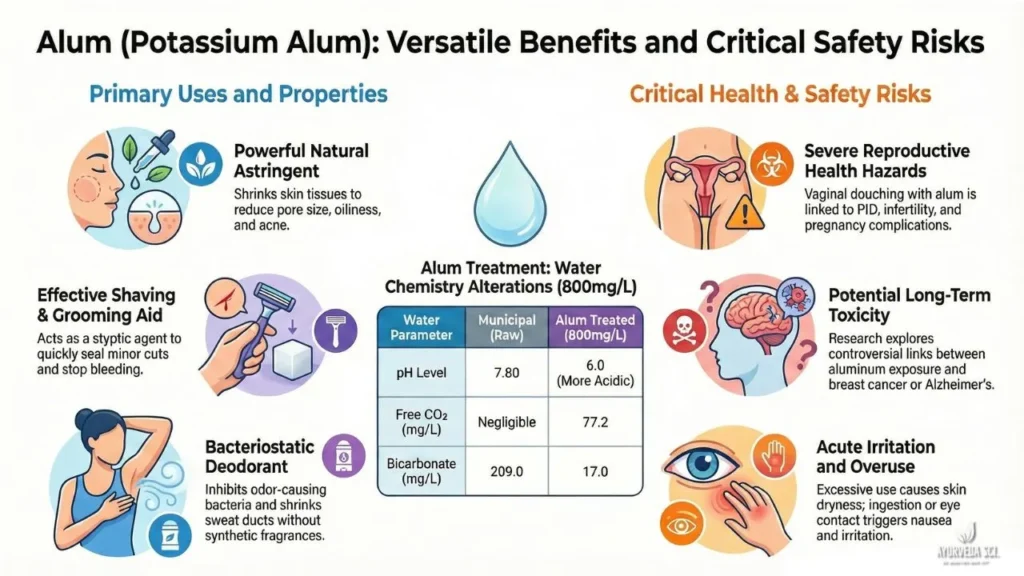
Modern dermatological science validates Alum’s traditional role as a powerful astringent and bacteriostatic agent. Its primary mechanism—tissue contraction—allows it to function as a bridge between ancient remedies and contemporary “clean beauty” protocols.
- Acne and Sebum Management: Alum effectively inhibits the growth of common pathogens like Staphylococcus aureus. By shrinking the appearance of pores and managing excess sebum, it prevents the anaerobic environments where acne thrives.
- Post-Shave Recovery and the “Mittal Case Study”: A significant modern endorsement came from entrepreneur Anupam Mittal, who advocated for “Phitkari” blocks as a superior alternative to commercial aftershaves. Mittal specifically cited the presence of “hormonal disruptors” and synthetic irritants in modern aftershaves as his reason for the switch. Alum serves as a natural hemostyptic, sealing minor nicks and disinfecting the skin without disrupting the endocrine system.
- Anti-Aging and Texture: The temporary “tissue contraction” caused by Alum reduces the visibility of fine lines and large pores, providing an immediate, albeit temporary, tightening effect.
- Body Odor: Functioning as a “crystal deodorant,” Alum targets odor-causing bacteria rather than clogging sweat ducts. It creates an acidic, bacteriostatic environment on the skin’s surface that prevents the breakdown of sweat into malodorous compounds.
4. The “Potent Pairings” Laboratory: DIY Alum Formulations
To maximize efficacy while mitigating potential dryness, Alum should be strategically combined with humectants and botanicals.
Targeted Alum Rituals
| Goal | Ingredients | Application Method |
| Dark Spot Correction | 2 tbsp Rose Water, 2 tbsp Alum Powder | Mix into a smooth paste. Apply to cleansed skin for 10 minutes, then rinse with lukewarm water. |
| Anti-Acne Toner | ½ cup Water, ¼ tbsp Alum, handful of Holy Basil, 4-5 drops Glycerin | Boil the water with the basil and alum together. Once dissolved, cool and strain into a spritzer. Add glycerin, refrigerate, and apply twice daily. |
| Scar & Blemish Mask | 1 tbsp Alum Powder, 2 tbsp Multani Mitti, 1 tbsp Milk | Combine into a paste. For a more powerful effect, use Alumen exsiccatum (purified, dried alum), which acts as a mild escharotic to resurface stubborn marks. Apply for 15 minutes. |
5. Beyond the Face: Systemic Health and Oral Hygiene
Alum’s versatility extends to internal-to-external transition zones and broader environmental health.
- Oral Health: Alum gargles are highly effective for treating mouth ulcers and bleeding gums (lissa damia). Research confirms it reduces Streptococcus mutans levels in the saliva, aiding in the prevention of tooth decay and halitosis.
- Water Purification: In rural and historical contexts, Alum acts as a flocculant, causing impurities to clump and settle. Chemically, it lowers the pH of water from approximately 6.0 to 4.0, a mechanism that effectively checks the growth of pathogens such as Vibrio cholerae.
- Hair and Foot Care: Alum’s antifungal properties make it a viable treatment for dandruff (pityriasis) and athlete’s foot. A foot bath infused with Alum can also heal cracked heels and eliminate foot odor by targeting bacterial colonies.
6. The Evidence Layer: Modern Research and Clinical Studies
Laboratory observations and clinical trials have authenticated Alum’s place in the modern pharmacopeia:
- Hemostyptic Efficacy: Clinical studies show a 75-78% success rate in using Alum irrigation to control massive bladder hemorrhages. Furthermore, the use of Alum as a hemostatic agent in tonsillectomies has been shown to reduce operation time by 28.6% compared to standard controls.
- Anticariogenic Effect: Trials involving children have demonstrated significant reductions in salivary Streptococcus mutans levels following Alum-based mouth rinses.
- Larvicidal Potential: Alum exhibits significant efficacy against the larvae of Anopheles stephensi, the primary vector for malaria.
- Anti-Obesity Potential: In studies involving Wistar rats fed a high-fat diet, oral intake of Alum led to a significant reduction in body weight and a marked decrease in biomarkers like serum triglycerides and total cholesterol.
7. Critical Safety and The “Vaginal Douching” Warning
The potency of Alum necessitates a rigorous safety analysis. While its benefits are significant, misuse can lead to severe physiological harm.
The Vaginal Health Warning: Social and Clinical Risks
Douching with Alum must be strictly discouraged. Beyond the clinical risks, ethnobotanical research (Anderson et al., 2008) notes that Alum is sometimes used as an “astringent” for vaginal tightening to “hide evidence of infidelity” or to make the vagina feel “younger.” These social misperceptions are dangerous. According to CEConnection data, Alum douching causes:
- Extreme mucosal dryness and disruption of the natural flora.
- Significantly increased risk of Bacterial Vaginosis (BV) and Pelvic Inflammatory Disease (PID).
- Elevated susceptibility to HIV transmission and other STIs.
- Increased risk of ectopic pregnancy and preterm birth.
General Toxicity and Nuance
- Ingestion: Oral consumption is generally discouraged due to gastrointestinal distress and potential kidney stress.
- Neurotoxicity: While aluminum is found in neurofibrillary tangles, current science suggests only a suggestive association between long-term aluminum exposure and Alzheimer’s disease; a direct causal link through topical Alum remains under research.
- Topical Side Effects: Excessive use leads to skin stinging, chronic flakiness, and potential eye damage (corneal thinning) if contact occurs.
8. Conclusion: Strategic Takeaways for the Conscious Consumer
Alum is a “magical stone” only when wielded with clinical precision. For the conscious consumer, it represents a high-value intersection of traditional ethnobotanical wisdom and modern safety boundaries.
Golden Rules for Alum Usage
- Patch Testing: Prior to widespread application, test Alum on a small skin area to identify potential sensitivity or allergic reaction.
- External Use Only: Its primary utility is topical. Avoid ingestion unless under strict professional medical supervision.
- Moderation is Mandatory: Overuse will degrade the skin’s lipid barrier. A minimal application is sufficient for its hemostyptic and astringent effects.
In the dialogue between ancient healers and modern dermatologists, Alum stands as a testament to the enduring efficacy of mineral medicine—provided it is used with an informed, cautious, and scientific mind.
Disclaimer: This content is for informational purposes only and is not intended as medical advice. Please consult a qualified healthcare professional before using alum or any other remedy.