
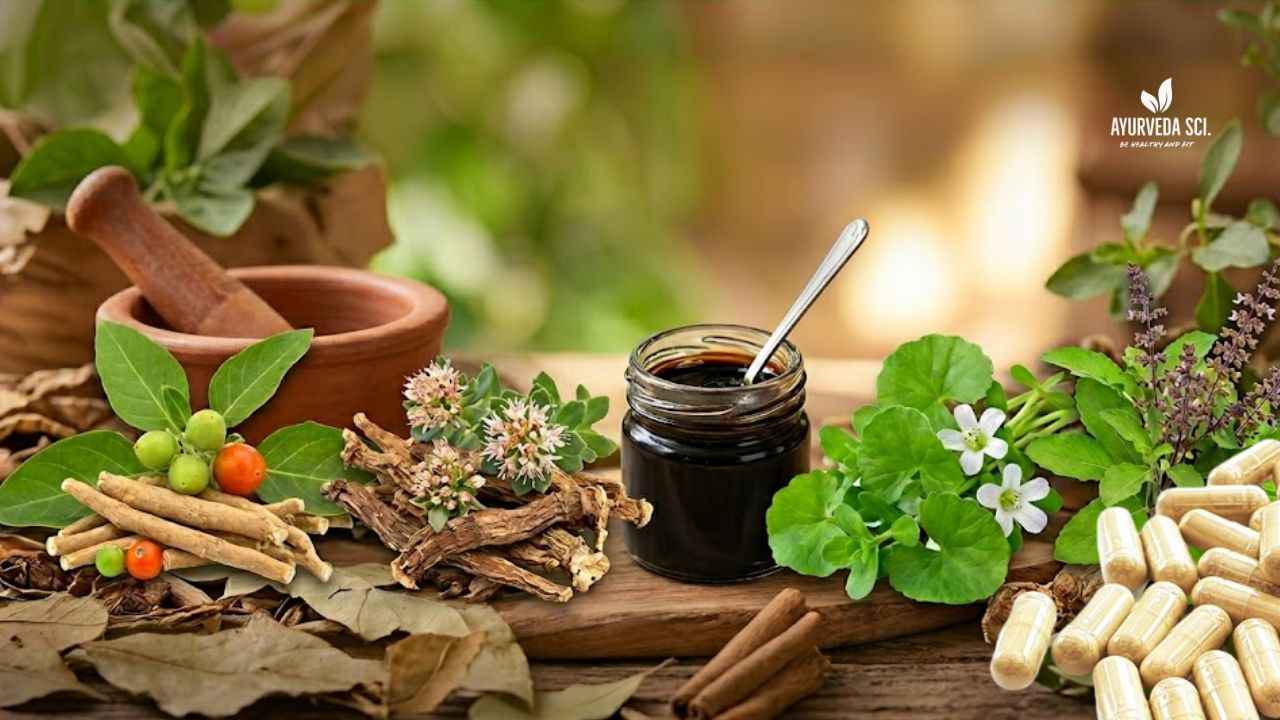
The word “adaptogen” gets used loosely — attached to almost any herb that claims to help with stress. In reality, a true adaptogen must meet a specific biological standard: it must help the body adapt to stressors of all kinds without disrupting normal physiological function, and it must be non-toxic at therapeutic doses. By that rigorous definition, only a handful of herbs qualify.
Ashwagandha is one of them. So are Rhodiola Rosea, Shilajit, Brahmi, and Holy Basil. These five herbs are the most clinically studied adaptogens in the Ayurvedic and broader herbal medicine traditions. They are often discussed interchangeably, as if they are simply different flavours of the same effect. They are not. Each works through a distinct mechanism, excels in a different context, and suits a different kind of person.
This section explains exactly how they differ — and more importantly, helps you decide which one you actually need.
The master comparison table
| Ashwagandha | Rhodiola Rosea | Shilajit | Brahmi (Bacopa) | Holy Basil (Tulsi) | |
|---|---|---|---|---|---|
| Primary mechanism | Lowers cortisol via HPA axis; GABA modulation | Modulates CNS; improves mitochondrial function | Fulvic acid + ATP production; mineral delivery | Inhibits acetylcholinesterase; neuronal repair | COX enzyme inhibition; cortisol rhythm regulation |
| Energy effect | Calming — reduces stress energy drain | Stimulating — raises physical energy | Restorative — cellular ATP production | Neutral — mental clarity without stimulation | Uplifting — gentle clarity, non-sedating |
| Best time to take | Evening / before bed | Morning / before activity | Morning with food | Morning or midday | Any time; traditionally as morning tea |
| Primary benefit | Stress, anxiety, sleep, hormones | Fatigue, focus, endurance | Physical energy, testosterone, mitochondria | Memory, learning, cognitive speed | Daily stress relief, immunity, blood sugar |
| Clinical trials (humans) | 22+ RCTs | 70+ clinical trials reviewed | Limited but growing | 20+ RCTs | Moderate; more needed |
| Tradition origin | Ayurveda (India, 6,000 years) | Eastern Europe / Scandinavia / Russia | Ayurveda — Himalayan mineral resin | Ayurveda (India) | Ayurveda (India) |
| Safety profile | Generally good; liver caution at high doses | Excellent; generally well-tolerated | Good when purified; avoid raw/untested | Good; mild GI side effects possible | Excellent; very safe for daily use |
| Suitable for vegans | Yes (check extraction method) | Yes | Yes (capsule form) | Yes | Yes (especially tea form) |
| Typical daily dose | 300–600 mg extract | 200–600 mg extract | 250–500 mg purified extract | 300–600 mg extract | 300–600 mg extract / 2–3 cups tea |
Ashwagandha vs Rhodiola Rosea

Of all the adaptogen comparisons, this is the one that matters most — because these two herbs are so widely co-recommended that many people take them together without understanding how differently they work.
Both adaptogens show effective anti-stress activity, but their mechanisms of action differ fundamentally. Rhodiola Rosea acts primarily on the central nervous system, demonstrating improvement in stress-induced fatigue, depression, and enhanced mental and physical performance. Ashwagandha exhibits serotonergic-dependent antidepressant effects and modulates GABAergic neurotransmission, making it more effective against stress-associated anxiety, nervousness, and insomnia.
The simplest way to understand the difference: Rhodiola has more of an energising effect while Ashwagandha has sleep-promoting effects. Rhodiola is a morning herb. Ashwagandha is an evening herb. Rhodiola fires you up. Ashwagandha winds you down — not into sedation, but into a calmer, more grounded state.
Ashwagandha works by reducing cortisol, which is beneficial for chronic stress and high anxiety levels. Rhodiola, by contrast, balances the stress response without causing drowsiness, making it a better choice for those who need to stay sharp and energised throughout the day.
Their active compounds are completely different. Ashwagandha’s primary actives are withanolides — steroidal lactones that interact with hormone systems. Rhodiola’s adaptogenic effects come from rosavin and salidroside, which enhance energy and mental clarity through a different neurochemical pathway entirely.
Choose ashwagandha if: You are chronically anxious, struggling with sleep, have elevated cortisol, want hormonal support, or need recovery from sustained burnout.
Choose Rhodiola if: You are dealing with acute fatigue, need mental stamina for a demanding project, want pre-workout energy support, or need to stay sharp without sedation during the day.
Can you take them together?
Yes, you can safely take ashwagandha and Rhodiola together, as both are well-tolerated and have excellent safety profiles. Since ashwagandha helps promote restful sleep, it may be better to use it at night, while Rhodiola provides energy boosts, making mornings a better time for its usage. The combination works well for people who need both daytime energy and evening recovery — a common pattern in chronically stressed, high-output individuals. Split the timing: Rhodiola in the morning, ashwagandha at night.
Ashwagandha vs Shilajit
Where Rhodiola is a stimulating adaptogen and ashwagandha is a calming one, Shilajit operates on a third axis entirely: cellular energy restoration at the mitochondrial level.
Shilajit is not a plant — it is a mineral-rich resin that seeps from Himalayan rock faces, formed over centuries from compressed plant matter and microbial metabolites. Its primary bioactive compound, fulvic acid, supports mitochondrial function by improving nutrient transport across cell membranes and reducing oxidative stress in the mitochondria — explaining why users consistently report reduced fatigue, better focus, and improved endurance after sustained use.
Testosterone synthesis in Leydig cells is energy intensive. Fulvic acid helps preserve mitochondrial function and support ATP production, which may indirectly aid steroidogenesis. Zinc and magnesium — essential for hormone production — are also carried into cells more efficiently by fulvic substances, which may improve cellular transport and bioavailability.
The clinical testosterone evidence for Shilajit is compelling. In a randomised, double-blind, placebo-controlled clinical study, purified Shilajit at 250 mg twice daily for 90 days significantly increased total testosterone, free testosterone, and DHEAS compared with placebo in healthy men aged 45–55. Separately, 200 mg of Shilajit daily for 90 days in infertile men was associated with a 23.5% increase in serum testosterone.
The key difference from ashwagandha on testosterone: Shilajit raises testosterone by supporting the raw cellular energy infrastructure that hormone synthesis depends on. Ashwagandha raises testosterone primarily by removing the cortisol brake that suppresses it. Both pathways are valid — they simply work at different ends of the same problem.
Choose ashwagandha if: Stress is the primary driver of your energy depletion or hormonal suppression. Sleep, anxiety, and cortisol are your main concerns.
Choose Shilajit if: Your energy problem feels more fundamental — a deeper physical depletion, poor cellular recovery, or fatigue that persists even when stress is managed. Also better for those whose testosterone support goals are energy and physical vitality rather than stress-related suppression.
When to combine them:
Ashwagandha and Shilajit are one of Ayurveda’s most traditional pairings — and the science supports why. Together, ashwagandha addresses the psychological and hormonal dimension of energy (stress, cortisol, sleep) while Shilajit addresses the physical and cellular dimension (ATP, mitochondria, mineral delivery) — creating comprehensive mind-body energy support neither provides alone.
Critical safety note on Shilajit: Quality is non-negotiable. Raw, unpurified Shilajit can contain significant levels of lead, arsenic, and mercury from its geological source. Choose only purified Shilajit standardised to at least 50% fulvic acid content, with third-party testing for heavy metals — this is what clinical studies use, and it is the only form considered safe for regular consumption.
Ashwagandha vs Brahmi (Bacopa monnieri)
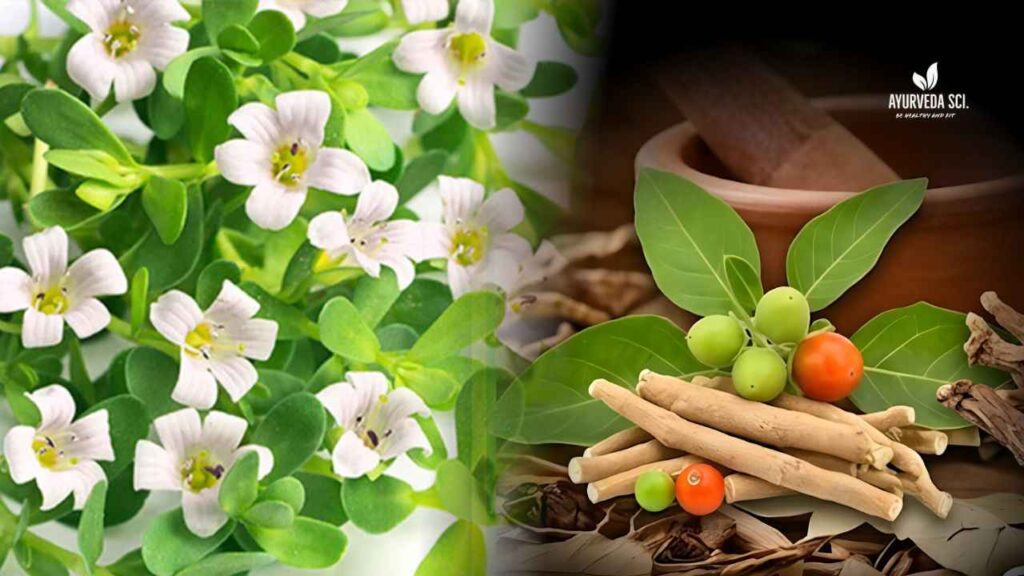
Both ashwagandha and Brahmi are classified as Medhya Rasayana in Ayurveda — herbs that specifically rejuvenate the mind. Both support cognition. Both reduce anxiety. On the surface, they seem interchangeable. Their mechanisms, however, are quite different.
Ashwagandha supports brain function primarily through two indirect routes: by reducing cortisol (which damages hippocampal neurons under chronic stress) and by its withanolides crossing the blood-brain barrier to exert neuroprotective and anti-inflammatory effects. Its cognitive benefit is most pronounced in people whose mental performance is impaired by stress and elevated cortisol.
Brahmi (Bacopa monnieri) takes a more direct neurochemical approach. Known in Ayurveda as a medhya rasayana and classified as a calming cognitive enhancer, Bacopa modulates the HPA axis and reduces acute stress reactivity, while longer-term use is associated with improvements in anxiety, mental resistance to stress, and emotional wellbeing — with its primary mechanism involving inhibition of the enzyme that breaks down acetylcholine, the key memory neurotransmitter.
Where ashwagandha makes you feel less stressed so your mind functions better, Brahmi directly enhances the neurochemical machinery of memory, learning, and information processing. Brahmi increases the activity of endogenous antioxidant systems, reduces damage from free radicals, and promotes memory and cognitive wellbeing through its direct action on neural tissue.
The practical distinction: ashwagandha is better for the person whose cognitive fog is caused by stress and sleep deprivation. Brahmi is better for the person who wants to directly enhance memory encoding, learning speed, and information retention — regardless of stress levels.
One important note about terminology: the name “Brahmi” is used in India to refer to two distinct plants — Bacopa monnieri (called Brahmi in Southern India) and Centella asiatica, known as Gotu Kola in the West (called Brahmi in Northern India). When purchasing a Brahmi supplement, always confirm the Latin botanical name on the label.
Choose ashwagandha if: Stress and sleep deprivation are driving your mental fog. You want whole-body adaptogenic support alongside cognitive benefit.
Choose Brahmi if: You are a student, writer, or knowledge worker wanting to directly improve memory retention, learning speed, and information processing. Your stress levels are manageable but your cognition needs a direct upgrade.
When to combine them:
Ashwagandha and Brahmi pair well for cognitive and neuroprotective support — ashwagandha helps regulate healthy neuronal growth and protects the brain from oxidative stress, while Brahmi directly mediates learning, memory, and clear thinking. For anyone in a demanding academic or professional season, this combination addresses both the stress-management layer and the direct cognitive enhancement layer simultaneously.
Ashwagandha vs Holy Basil (Tulsi)
Holy Basil — known as Tulsi (Ocimum sanctum) — is one of the most sacred plants in Indian culture, present in most Hindu households, used in daily religious practice and as a household remedy for centuries. In Ayurvedic tradition, Tulsi is considered the “Queen of Herbs” — an adaptogen that is uplifting and calming simultaneously, helping the body adapt to day-to-day stress without inducing sedation, while supporting immune health and mental clarity.
Where ashwagandha works deep — resetting cortisol baselines over weeks through HPA axis recalibration — Tulsi works at a gentler, more daily-maintenance level. In a randomised study of 100 participants, those taking Holy Basil for 8 weeks reported feeling less stressed, had lower cortisol levels, and reported better sleep — though the effects were measured by self-report rather than objective sleep monitoring.
Tulsi’s mechanism is also distinct. Rather than acting primarily on the HPA axis, it inhibits the COX enzyme pathway (the same pathway targeted by ibuprofen, but through a gentler natural mechanism), supports healthy cortisol diurnal rhythm, and provides dense antioxidant and immune-supporting benefits through its eugenol, rosmarinic acid, and flavonoid content.
Studies have shown that Tulsi can mediate learning, memory, and clear thinking — making it a cognitive support herb as well as a stress herb — and its pairing with ashwagandha is considered synergistic in Ayurvedic tradition, with Tulsi providing uplifting clarity while ashwagandha provides deep revitalisation.
Tulsi has one major practical advantage over every other adaptogen in this comparison: it is the only one you can take daily as a cup of tea, without capsules, without standardised extracts, without measuring doses. Two to three cups of Tulsi tea daily delivers a genuine therapeutic dose in its traditional form — something none of the other herbs in this comparison can match.
Choose ashwagandha if: Your stress is chronic and severe, your sleep is poor, your cortisol is measurably elevated, or you have specific hormonal goals. You need a clinical-grade adaptogen.
Choose Tulsi if: You want a gentle, everyday adaptogen that can be taken as a ritual cup of tea, supports immunity alongside stress, and blends into daily life without a supplement protocol. It is also better for those with mild, situational stress rather than deep-seated burnout.
When to combine them:
Tulsi and ashwagandha pair naturally for whole mind-body balance — Tulsi uplifts while ashwagandha revitalises, creating a complementary effect that addresses both the energy and the grounding dimensions of stress. Take Tulsi as a morning tea and ashwagandha as an evening capsule — a protocol that aligns perfectly with their respective energetic profiles and timing.
The decision guide: which adaptogen suits your primary goal?
| Your primary goal | Best choice | Second choice | Consider combining |
|---|---|---|---|
| Chronic stress & anxiety | Ashwagandha | Holy Basil (Tulsi) | Both — tea in morning, capsule at night |
| Energy & daytime focus | Rhodiola Rosea | Shilajit | Rhodiola (AM) + Ashwagandha (PM) |
| Sleep quality | Ashwagandha | Holy Basil | Ashwagandha + Tulsi evening tea |
| Memory & learning | Brahmi (Bacopa) | Ashwagandha | Both — directly complementary |
| Testosterone & male vitality | Shilajit | Ashwagandha | Both — works on different pathways |
| Physical energy & recovery | Shilajit | Rhodiola | Shilajit + Ashwagandha (traditional pairing) |
| Immune & daily wellness | Holy Basil (Tulsi) | Ashwagandha | Tulsi tea daily + Ashwagandha cycles |
| Burnout & deep exhaustion | Ashwagandha | Shilajit | All three: Ashwagandha + Shilajit + Rhodiola |
| Cognitive protection (ageing) | Brahmi (Bacopa) | Ashwagandha | Both + Shilajit (fulvic acid neuroprotection) |
A note on combining adaptogens
Combining adaptogens is common practice in both traditional Ayurveda (where polyherbal formulations are the norm rather than the exception) and in modern supplement formulations. A few practical principles apply:
Start with one adaptogen at a time. Running two or three simultaneously makes it impossible to know which one is working and which one might be causing any side effects. Run each herb solo for 4–6 weeks first. Only then introduce a second.
When combining, reduce individual doses. If you take 600 mg of ashwagandha solo and want to add Shilajit, drop the ashwagandha to 300 mg and start Shilajit at its lowest effective dose (250 mg). The combined adaptogenic load is greater than either alone.
Not all combinations are additive. Ashwagandha and Rhodiola have somewhat opposing energy profiles — ashwagandha calms, Rhodiola stimulates. Taken together at full doses, they can create conflicting signals. Time them appropriately (Rhodiola morning, ashwagandha evening) rather than taking both simultaneously.
Disclaimer: The herb comparisons and combination guidance in this section are based on published clinical and traditional evidence and are provided for informational purposes only. They do not constitute medical advice. Always consult a qualified healthcare provider before starting any new supplement, particularly if you are on prescription medication or managing a chronic health condition.
Recommended for you: