
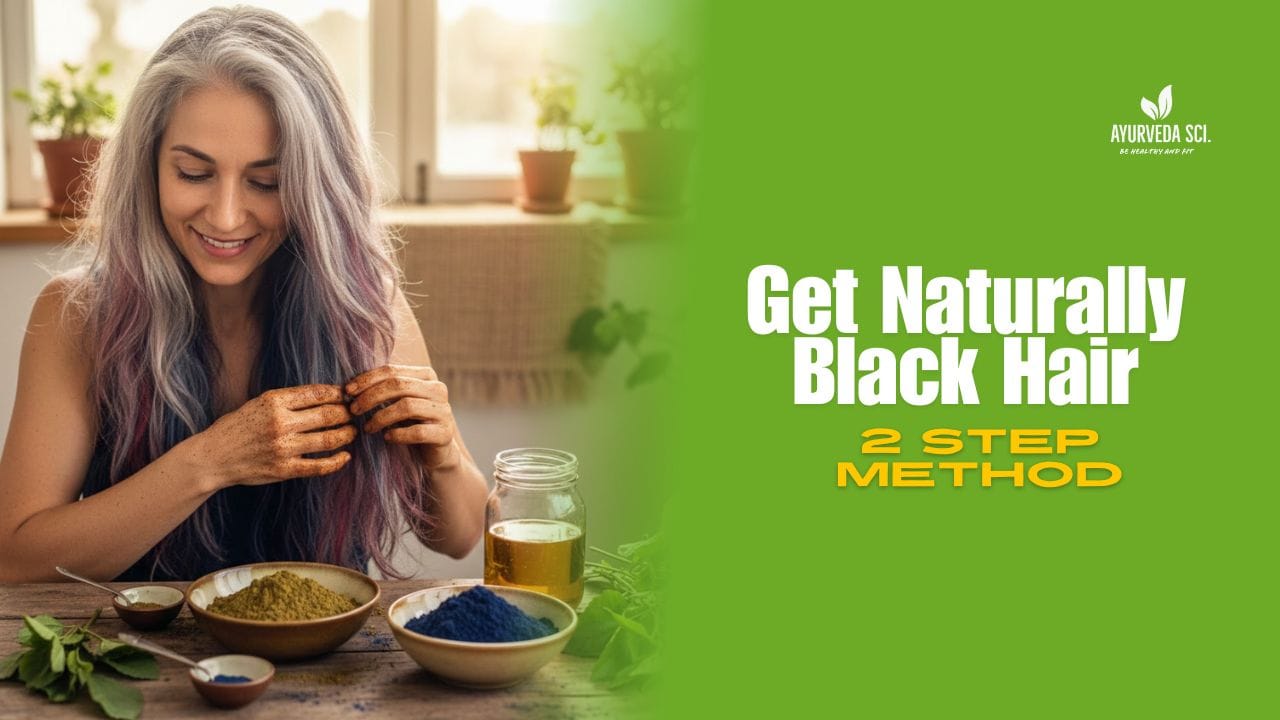
Your Journey to Naturally Beautiful Hair
If you’re tired of the chemical smell, scalp irritation, and brittle results from commercial hair dyes packed with PPD, ammonia, and hydrogen peroxide, you’ve found the natural solution. Those harsh chemicals can weaken hair follicles and cause allergic reactions, but there is a better way.
This guide introduces a safe and effective two-step method using henna and indigo. This ancient practice is more than just a dye; it’s a deeply nourishing treatment. Henna not only imparts a beautiful red-brown base color but also conditions the hair, reduces breakage and split ends, and forms a natural UV protection layer. This process will leave your hair stronger, shinier, and healthier—all without the negative side effects of chemical products.
1. Gathering Your Supplies
Before you begin, you’ll need to gather a few key ingredients and tools. This process uses all-natural herbal powders for a rich, deep color.
1.1. Herbal Powders & Ingredients
- Henna (Mehndi) Powder
- Indigo (Neel Patti) Powder
- Amla Powder (Optional, but recommended for better color)
- Bhringraj Powder (Optional, but recommended for better color)
- Aloe Vera Gel
- Black Tea Leaves (for making tea water)
1.2. Tools & Equipment
- An iron pot or bowl (लोहे की कढ़ाई). The iron in the pot reacts with the tannins in the henna to produce a darker, richer color.
- Mixing spoon
- Plastic wrap or a polythene sheet
- Gloves for application
- A small pot for boiling tea water
With your supplies ready, let’s look at the two-step method that makes this natural dye so effective.
2. The Two-Step Process: An Overview
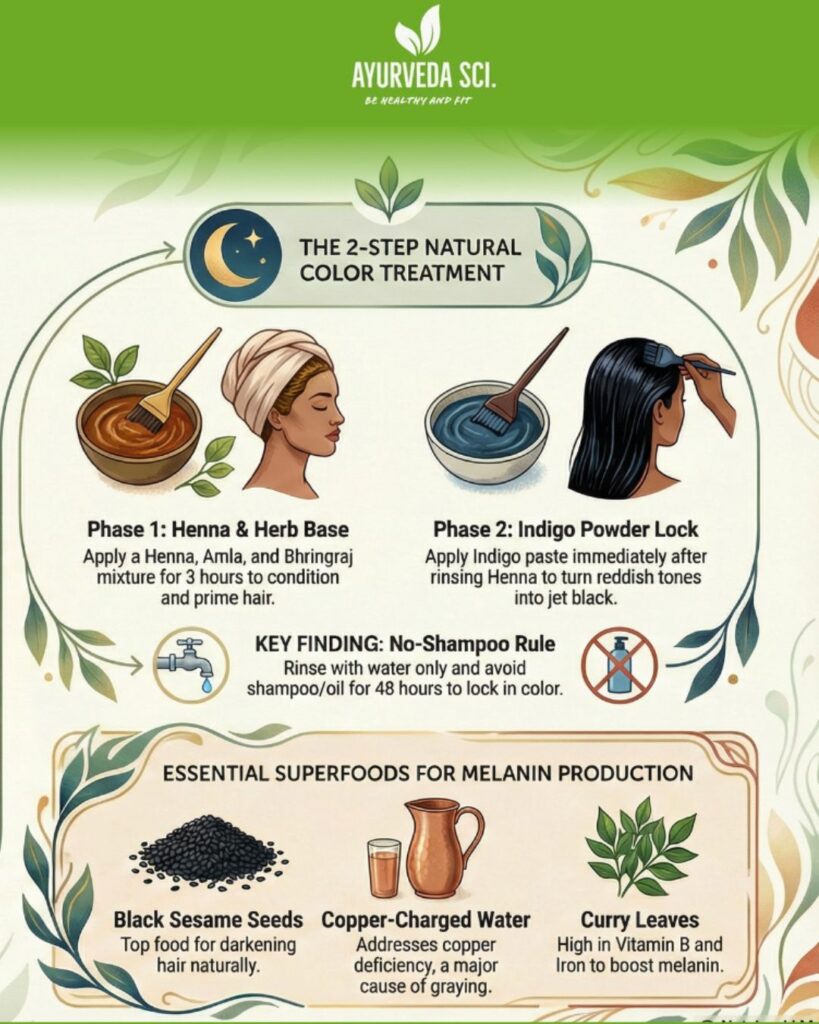
The key to achieving a deep brown or black color with herbs is a two-step process. This is not a single mixture, but two separate applications performed one after the other.
Here’s the core concept:
- Step 1 (Henna): You first apply a henna-based paste. This creates a foundational red-brown base color on your hair.
- Step 2 (Indigo): Next, you apply an indigo paste over the henna-treated hair. The indigo reacts with the henna base to achieve the final deep brown or jet-black shade.
Now, let’s break down the first step in detail.
3. Step 1: The Henna Base Application
This initial step is crucial for creating the base color that the indigo will bond to. Preparation is best done the night before you plan to color your hair.
3.1. Preparing the Henna Paste (The Night Before)
- Prepare the Tea Water: Boil one tablespoon of tea leaves in a glass of water until the water takes on a dark color.
- Combine Powders: In the iron pot, mix 3 tablespoons of henna powder with 1 tablespoon of amla powder and 1 tablespoon of bhringraj powder.
- Add Aloe Vera: Mix in 2 tablespoons of aloe vera gel. This helps counteract the natural dryness that henna can cause and ensures a uniform, even color application.
- Create the Paste: Gradually add the hot tea water to the powder mixture, stirring continuously to create a smooth paste with no lumps. Save a small amount of the tea water for the indigo step later.
- Let It Rest: Cover the iron pot with plastic wrap to prevent the top layer from drying out. Leaving it overnight is essential as it allows the henna to release its natural pigment (lawsone), which results in the best possible color.
Pro Tip: If you don’t have amla or bhringraj powder, you can still proceed with henna, aloe vera, and tea water. However, including them results in a better, darker color and provides extra nourishment for your hair.
3.2. Applying the Henna
- Start with Clean Hair: Wash your hair with a mild, natural shampoo and let it dry completely. This removes any oil or dirt that could block the color from adhering properly.
- Apply the Paste: Wearing gloves, apply the henna paste thoroughly. Make sure you cover all your hair, from the roots to the very ends.
- Wait: Leave the henna paste on your hair for 3 hours.
- Rinse Thoroughly: Rinse the henna out using only water.
CRITICAL NOTE: Do NOT use shampoo at this stage. Using shampoo will remove the henna molecules that are essential for the indigo in Step 2 to work correctly and create a dark color. Your hair will have a reddish-brown tint after this step.
With the henna base successfully applied, you are now ready for the second and final step to achieve your desired dark color.
4. Step 2: The Indigo Color Application
This step must be done immediately after rinsing out the henna. The timing of the indigo paste is critical for achieving a vibrant, dark shade.
4.1. Preparing and Applying the Indigo Paste (Immediately After Rinsing Henna)
- Mix the Indigo: In a clean bowl, take an amount of indigo powder equal to the henna powder you used (e.g., 3 tablespoons).
- Create the Paste: Gently warm the tea water you saved from the previous step and mix it into the indigo powder to form a smooth paste.
- Apply Immediately: Apply the indigo paste to your henna-treated hair right away.
IMPORTANT: Do not let the indigo paste sit after mixing. Its dyeing properties begin to degrade as soon as water is added, so it must be applied to the hair immediately for the best results.
4.2. Timing for Your Desired Color
The length of time you leave the indigo paste on your hair determines the final color. Use this table as a guide:
| Desired Color | Application Time |
| Dark Brown | 30-40 minutes |
| Jet Black | 1.5 – 2 hours |
Leaving the paste on for more than 2 hours provides no extra benefit.
Once your time is up, the next steps are crucial for ensuring your new color lasts.
5. Crucial Aftercare: Locking in Your Color
Following these post-application rules is essential for achieving a deep, long-lasting color that won’t fade prematurely.
- Rinse with Water Only After the required time has passed, rinse the indigo paste out thoroughly using only water. Do not use any shampoo or conditioner.
- No Shampoo for 2 Days Do not use shampoo on your hair for at least 48 hours. This waiting period allows the indigo molecules to fully oxidize and “lock” into your hair shafts. Shampooing too soon will strip the color before it has set, causing it to fade significantly.
- No Oiling for 48 Hours Avoid applying any hair oil for at least 24 hours, and preferably 48 hours. While your hair may feel temporarily dry, this step is essential for achieving the best possible jet-black result. The color will continue to darken and deepen during this 48-hour period.
By following these aftercare steps, you can look forward to beautiful, naturally colored hair.
6. What to Expect & Maintaining Your Color
Here’s what you can anticipate after completing this natural coloring treatment:
- Initial Dryness: It’s normal for your hair to feel a bit dry right after the treatment, but this is temporary. After the 48-hour waiting period, you can oil and condition your hair as usual to restore moisture.
- Color Development: The final color will develop and deepen over the next 48 hours as the indigo oxidizes. Be patient and watch the beautiful, rich shade emerge.
- A True Transformation: This is more than a color treatment; it’s a complete hair transformation. You will see not only beautifully colored hair but also stronger roots, reduced breakage, and a stunning natural shine.
- Maintenance: For completely white hair, you can repeat this two-step process every 15 to 30 days. After 2-3 consistent applications, the color will become deep, rich, and uniform.
Recommended for you: