
Body Mass Index (BMI) Calculator – Calculate Your Body Mass Index Free
BMI Calculator
Check your Body Mass Index in seconds
Please enter valid height and weight values.
Underweight • Normal • Overweight • Obese
BMI is a general screening tool and does not account for muscle mass, bone density, or body composition. Consult a healthcare provider for personalized advice.
Related Tools: Water intake Calculator
BMI Calculator: How to Calculate Your Body Mass Index (2026 Guide)
Wondering if you're at a healthy weight? The BMI calculator above gives you an instant answer using your height and weight. This guide explains exactly what BMI is, how it's calculated, what your result means, and where BMI falls short — so you can use the number wisely, not just stare at it.
What Is BMI?
Body Mass Index (BMI) is a screening measurement that estimates whether your weight is appropriate for your height. It's calculated by dividing your weight in kilograms by your height in meters squared.
Doctors, researchers, and public health organizations — including the World Health Organization and the CDC — use BMI as a quick, low-cost way to flag people who may be at higher risk of weight-related health issues. It doesn't diagnose anything on its own, but it's a useful starting point for a broader health conversation.
How Is BMI Calculated?
The standard formula is:
BMI = weight (kg) ÷ height² (m²)
Metric example: A person weighing 68 kg who is 1.75 m tall has a BMI of: 68 ÷ (1.75 × 1.75) = 22.2
For those using pounds and inches, the imperial formula is:
BMI = (weight (lb) ÷ height² (in²)) × 703
Imperial example: A person weighing 150 lb at 5'6" (66 inches) tall has a BMI of: (150 ÷ 66²) × 703 = 24.2
Rather than calculating by hand, just enter your details into the BMI calculator above and get your result instantly, in either metric or imperial units.
BMI Categories and What They Mean
| BMI Range | Category | General Health Risk |
|---|---|---|
| Below 18.5 | Underweight | Increased risk |
| 18.5 – 24.9 | Normal weight | Lowest risk |
| 25 – 29.9 | Overweight | Increased risk |
| 30 – 34.9 | Obese (Class I) | High risk |
| 35 – 39.9 | Obese (Class II) | Very high risk |
| 40 and above | Obese (Class III) | Extremely high risk |
These ranges come from World Health Organization classifications and are the same standard used by most healthcare providers.
Why Measuring Your BMI Matters
BMI is widely used because it's linked, on a population level, to several health outcomes — including cardiovascular disease, type 2 diabetes, high blood pressure, and certain cancers. Tracking your BMI over time (rather than looking at a single reading) can help you notice trends and have more informed conversations with your doctor.
That said, BMI is a screening tool, not a diagnosis. A high or low BMI is a signal to look closer — not a verdict on your health.
Limitations of BMI: What It Doesn't Measure
BMI is popular because it's simple, but that simplicity comes with real trade-offs.
What BMI gets right:
- Quick, free, and requires only height and weight
- Useful for tracking trends over time
- A reasonable population-level indicator of weight-related health risk
What BMI misses:
- It doesn't distinguish between muscle and fat, so muscular or athletic individuals often score "overweight" despite low body fat
- It doesn't account for where fat is stored (visceral fat around organs is riskier than fat elsewhere)
- It doesn't adjust for age, sex, or ethnicity, even though healthy body composition varies across these groups
- It isn't reliable for pregnant women, children, or older adults with reduced muscle mass
For a fuller picture, doctors often pair BMI with waist circumference, body fat percentage, or blood tests.

Who Should Use a BMI Calculator?
Most adults can use BMI as a quick, general check-in on their weight relative to height. It's especially useful if you're:
- Tracking weight changes over time
- Setting a general benchmark before starting a fitness or nutrition plan
- Preparing for a doctor's visit and want a starting data point
It's less useful — or potentially misleading — for competitive athletes, bodybuilders, pregnant or breastfeeding women, growing children and teens, and adults over 65, where muscle loss can mask fat-related risk.
BMI For Women
BMI chart for women helps you understand it properly.
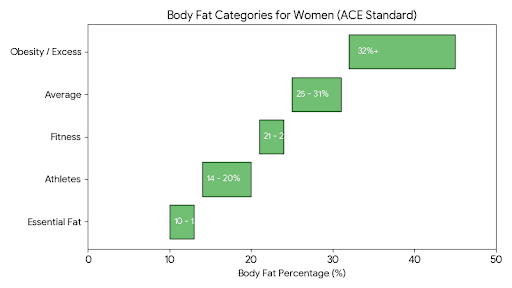
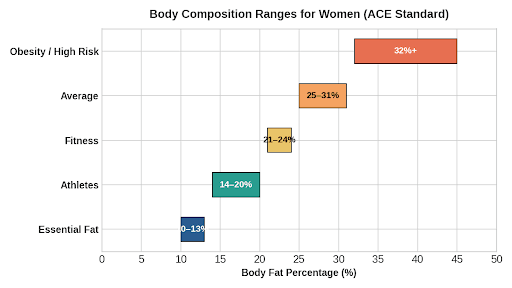
Body mass evaluation in women accounts for both overall weight relative to height (Body Mass Index) and body composition (the ratio of fat mass to lean muscle mass). Women naturally require a higher percentage of essential fat than men to support hormonal, metabolic, and reproductive functions.
Standard BMI Categories
| Category | BMI Range (kg/m2) | Health Indication |
| Underweight | Below 18.5 | Higher risk of nutrient deficiency and bone loss |
| Healthy Weight | 18.5 – 24.9 | Lower risk of metabolic and cardiovascular issues |
| Overweight | 25.0 – 29.9 | Elevated health risk (unless due to high muscle mass) |
| Class 1 Obesity | 30.0 – 34.9 | Moderate clinical health risk |
| Class 2 Obesity | 35.0 – 39.9 | High clinical health risk |
| Class 3 Obesity | 40.0 or higher | Severe clinical health risk |
Note: For adults 65 and older, a slightly higher BMI range of 23–27 is considered protective. For Asian women, lower metabolic thresholds apply, with overweight beginning at BMI 23.
Body Fat Percentage Ranges (ACE Guidelines)
| Classification | Body Fat Range | Description |
| Essential Fat | 10% – 13% | Bare minimum required for survival and hormone regulation |
| Athletes | 14% – 20% | Typical for endurance or competitive athletes |
| Fitness | 21% – 24% | Optimal lean composition for active individuals |
| Average | 25% – 31% | Typical healthy range for non-athletic women |
| Obesity / High Risk | 32% or higher | Linked to elevated risk for metabolic syndrome and diabetes |
Key Assessment Factors
- Visceral Fat & Waist Metric: A waist circumference exceeding 35 inches (88 cm) indicates high visceral fat around internal organs, which carries metabolic risk even if BMI appears normal.
- Hormonal & Life Stage Shifts: Estrogen fluctuations during pregnancy, postpartum, and menopause naturally alter body fat distribution toward the midsection and lower muscle maintenance rates.
- Limitations of Standalone BMI: BMI measures total mass rather than fat-to-muscle ratio. Muscular women often register as "overweight" on BMI charts despite having healthy body fat levels.
Frequently Asked Questions
What is a healthy BMI?
A BMI between 18.5 and 24.9 is generally classified as a healthy or "normal" weight range for most adults.
Is BMI accurate for everyone?
No. BMI doesn't account for muscle mass, bone density, age, sex, or ethnicity, so it can be misleading for athletes, older adults, and some other groups. It works best as a general screening tool, not a precise diagnostic.
How often should I check my BMI?
There's no fixed rule, but checking every few months — rather than daily — gives a more meaningful picture of trends without over-focusing on day-to-day weight fluctuations.
Does BMI apply the same way to men and women?
The calculation formula is identical for men and women, but body composition naturally differs by sex, which is one reason BMI should be considered alongside other health indicators.
What should I do if my BMI is outside the normal range?
Talk to a doctor or registered dietitian. They can look at your BMI alongside other factors — like waist circumference, activity level, and bloodwork — to give you a fuller, more personalized picture.
The Bottom Line
BMI is a fast, free way to get a general sense of whether your weight is in a typical range for your height. Use the calculator above to check your number, but treat the result as a starting point for a conversation about your health — not the final word. For a complete picture, combine your BMI with other measures and, ideally, a conversation with a healthcare provider.
This calculator and article are for informational purposes only and are not a substitute for professional medical advice.